Most recently a tendon-driven robotic gripper at HIROTEC America. Right now, parachute recovery hardware for a student rocket and an ultraviolet imager headed for 90,000 ft.
Study
B.S.E. Aerospace Engineering, Minor in Business, 2029
Focus
Mechanical design, test, and systems engineering
Based
Ann Arbor, Michigan
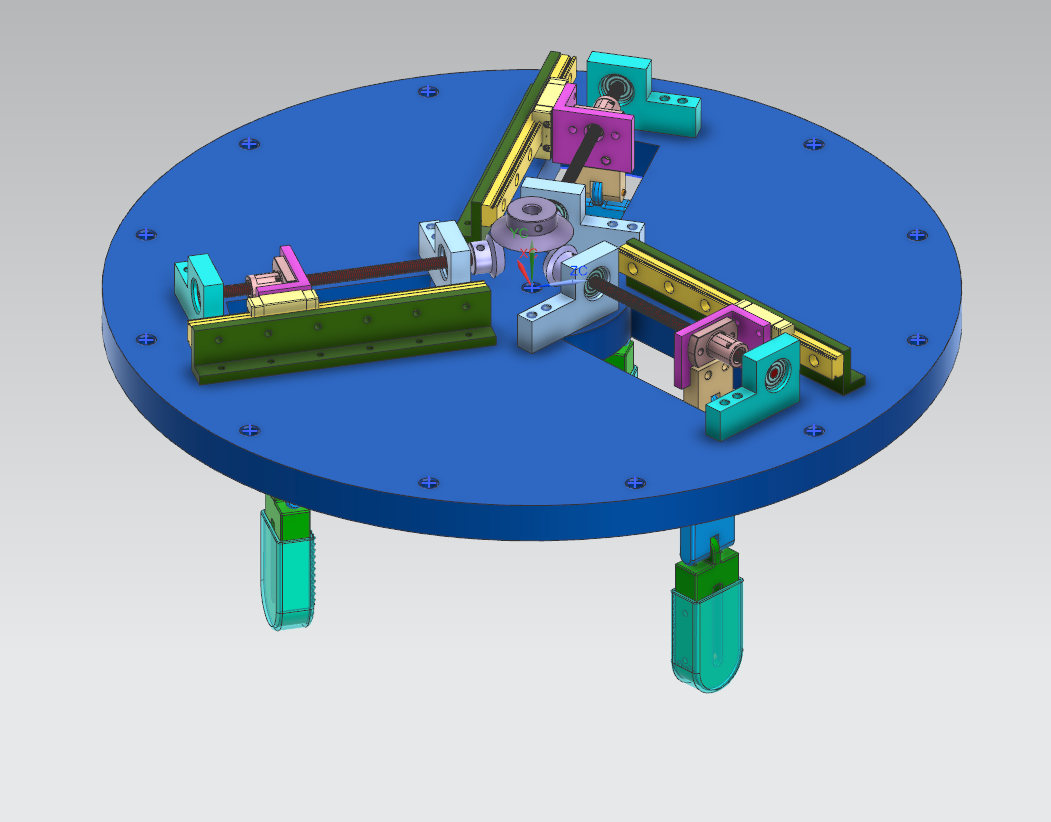
Fig. 1Three-finger end effector concept with radial rails, so the grip can open or close around parts of different sizes. Siemens NX.
A gripper that holds 5 to 20 kg parts of any shape
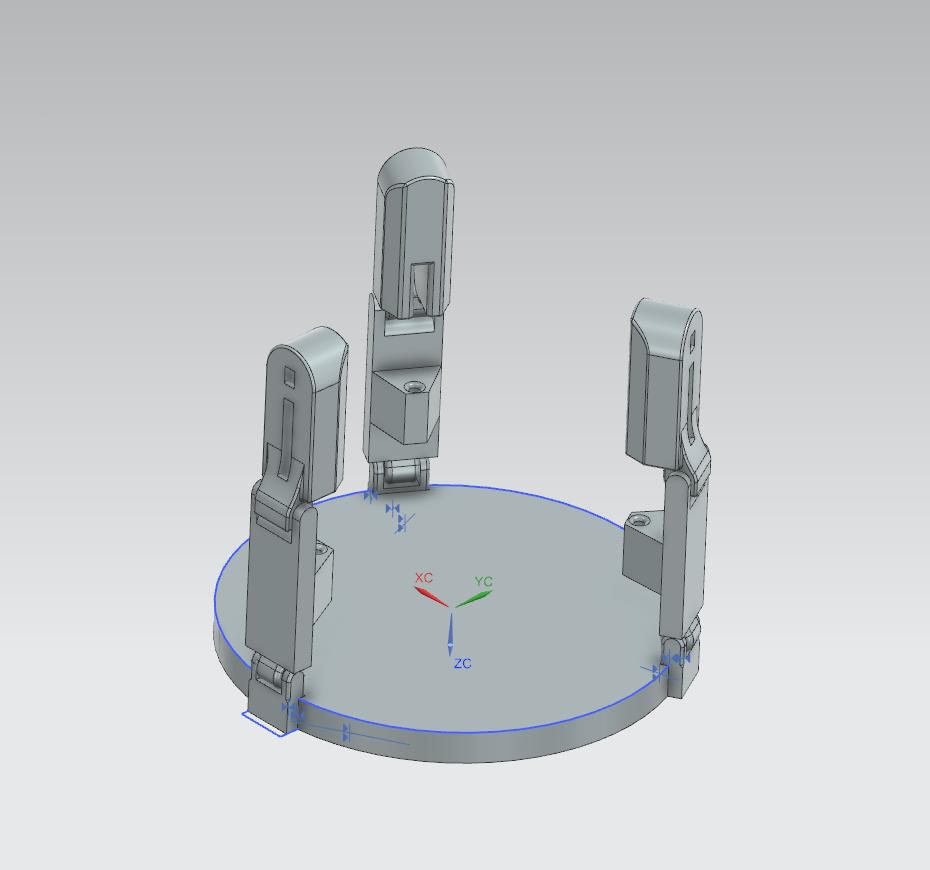
HIROTEC builds body-in-white tooling for automakers, and every new part shape usually needs its own custom end-of-arm tool. I pitched a flexible alternative: a three-finger, six-motor gripper whose fingers are pulled by tendons the way human fingers are.
As the sole project champion, I took it from requirements through verification, with intern support I directed. The design was presented to executives and the Japanese parent company, and it compared well against their own multi-month effort.
Fig. 2Finger assembly. Each finger has two joints driven by antagonistic tendon pairs.
Teams & coursework
Rockets, imagers, and aircraft
02
Michigan Aeronautical Science Association Aug 2025 to present
Reefed parachute and tether shock loads
Chutes & Tethers Responsible Engineer, Recovery
Leading a parachute and tether shock-load verification test, backed by a MATLAB dynamic model that predicts system response, to show structural integrity to 4,000 lbf for flight certification.
Designing a skirt-reefed main parachute that disreefs in stages, so one canopy replaces a three-parachute recovery system while keeping opening shock low.
Building a 6-DOF flight simulator in C++ on NASA's Trick and JEOD frameworks, including job scheduling, integration loops, and physics models for multiple rocket configurations.
Fig. 3Opening shock from my Knacke-based MATLAB model of the single reefed canopy: a 383 lbm rocket, 24 ft canopy reefed to 7 ft at apogee and cut free at 1,000 ft. Early estimate with placeholder inputs; peak load leaves a 3.4× margin on the 5,000 lb bridle.
03
MathWorks & Space Physics Research Lab Aug 2026 to present
MAAX ultraviolet imager proof of concept
Risk Lead & Avionics, AEROSP 388
Lead risk management for a team using model-based systems engineering to scope UV imaging analysis for MAAX, a candidate NASA Heliophysics SMEX mission. I brief MathWorks and SPRL stakeholders every two weeks.
Defined objectives and requirements for analyzing auroral UV imagery from the MAAX Ultraviolet Imager (MUVI), and carried the design through several reviews to a baseline.
Integrating the lens, avionics, and camera for a weather balloon flight to 90,000 ft to prove the concept.
04
Engineering 100: Rocket Science Aug to Dec 2025
Sensor-payload rocket
Design Team Member
Took a sensor-payload rocket through design, build, integration, launch, and flight-data analysis, and defended it at a Preliminary Design Review and a Flight Readiness Review.
When the landing point drifted from what simulation predicted, I worked through the flight data and wrote the root cause analysis.
05
M-Fly, SAE Aero Design Aug 2025 to May 2026
Airfoil and aircraft analysis
Aerodynamics Team Member
Ran airfoil and full 3D aircraft analyses in AVL and STAR-CCM+ to check the design against critical flight parameters and drag targets. The design changes that came out of it cut takeoff time by 20%.
Experience & education
Where I've been
2025 – 2029University of MichiganB.S.E. Aerospace Engineering, Minor in Business · GPA 3.87Ann Arbor, MI
May – Aug 2026HIROTEC AmericaResearch & Development Intern, Robotic End Effector Project ChampionAuburn Hills, MI
Expected 2027INCOSE Systems Engineering CertificationInternational Council on Systems Engineering
Relevant coursework: Aerospace Structures, Dynamics & Vibrations, and the Space Systems MBSE project (AEROSP 388).
About
I like problems where the math has to survive contact with real hardware. At HIROTEC that meant learning from the first 3D-printed finger that our torque model was wrong, then building a load-cell rig to settle it. Outside engineering I follow finance and football, build websites, and play poker. I'm also part of AIAA's Professional Development Committee and 42 Strong.
Software & code
MATLAB
C++
Python
Arduino
Linux / Bash
Siemens NX
CadQuery
STAR-CCM+ (CFD)
AVL
NASA Trick / JEOD
Systems engineering
Model-based systems engineering
Stakeholder needs & requirements
Risk management
Design reviews (PDR, FRR)
Verification & test planning
System integration
Root cause analysis
Fabrication & hardware
3D printing (FDM, TPU)
Machining
Soldering
Stepper motor control
Load cell instrumentation
Contact
Looking for internships in aerospace and robotics hardware.